 English
  日本語
日本語  Italiano

August 2020 : Voice of young people
This year, because of Covid-19, the annual courses on the meaning and value of human life from a religious perspective, which Shinmeizan has been holding over the last twenty years for students of the University of Industrial Medicine, have been canceled. We fill the lack of special news for this month with the impressions and comments sent to us by some of the young people who have stayed with us for some time this year.
Anna Freitag (Germany) In January 2020 I spent some days in Shinmeizan, located beautifully on a mountain in Kumamoto-Prefecture. For me these were some of my last days in Japan. I had been in Kyoto since September 2020 for studying religions. During these months I had learned a lot about Buddhism, Shintoism and New Religions in Japan but also about Christianity. I am a Christian myself and for me the stay at Shinmeizan turned out to be the most wonderful opportunity to say farewell to Japan.
I enjoyed those days very much. For one thing, the time was personally enriching for me. I enjoyed the devotions, the silent prayers in the morning and in the evening and I got to know the practice of zazu. At Shinmeizan I had a lot of time to think in peace and in a little distance from everyday life and could review the past months that I had spent in Japan.
On the other hand, the stay was a continuation of my studies. I learned a lot about inter-religious dialogue through conversations, but also very practically by being able to take part in the life of the monastery. Whenever I had more in-depth questions, I was provided with interesting articles from the small library commenting on those topics.
I am very thankful for the kindness which which I was welcomed there.
I am thankful for being invited to prayer and mass.
I am thankful for (and still surprised) about the german “Christmas Stollen“ you shared with me.
I am thankful for the wonderful sunsets and the wonderful sunrises.
I am thankful for all the open talks and thankful for the times we spent together in silence.
Luca Cuffaro (Italy)
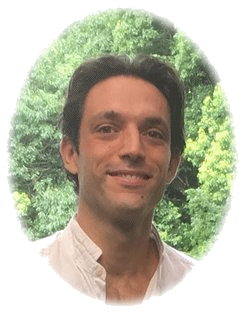 Although my arrival in Japan coincided with a typhoon, which luckily spared Kumamoto prefecture, the impact with the Japanese world was unforgettable. My long-awaited journey had several goals. In my work, I grow ornamental plants: camellias, azaleas and Japanese maples at a large nursery in Verbania (Novara). What better destination, then, to visit the homeland of the cultivated camellia? Just in Kumamoto, my main destination, in fact, the first hybrids of camellias "Higo" saw the birth and the cultivation of this magnificent plant started centuries ago right from the south of Japan! It was my desire to also see some tea plantations that I was able to visit in the surroundings of Uji (Kyoto).
The main destination of my trip was, however, the Shinmeizan Centre where I stayed for about a month and where I was blessed to find in Fr. Franco Sottocornola, Fr. Peter Yoshiaki Sonoda, Maria De Giorgi and Emiko Tomozoe great masters and experts of Japanese history, culture and religiosity who welcomed me and taught me the basics of the correct approach to the Japanese world.
The Shinmeizan history is a “pearl” worth to be known by everyone approaching the Land of the Rising Sun. The events of the master Furukawa and the courage of Father Franco in building and maintaining a truly unique reality are exemplary. Visits to temples and museums, the walking along common streets of the cities I later visited: Osaka, Kyoto, Hiroshima, Nagasaki, Kagoshima, the beautiful Nara, would not have impressed me so deeply if I hadn't had their guide. This allowed me "in the middle of the walk" [of my] life" to humbly experience Japan, as a courteous and respectful visitor.
My stay at Shinmeizan was intense but unfortunately too short! Even now, every memory of that experience brings me joy. My heart was filled every evening with the sunsets of Shinmeizan and the landscapes I could contemplate. The 'little' I could see had a deep impact on me thanks to the wise words received at Shinmeizan every morning, during prayer, and every evening around the shared table. I came back extremely enriched at human, cultural and spiritual level. A second visit will not fail, I hope soon!
Anna Dal Ri’ (Italy)
 My experience at Shinmeizan has been an experience of “Beauty”. I was immediately captivated by the beauty of the place itself: small Japanese-style wooden houses, surrounded by luxuriant vegetation and connected by pretty gravel paths.
The Center is located on top of a cypress and bamboo hill from which it is possible to see the sun rising from Mount Aso and setting in the Ariake sea. The second form of “Beauty” that I still treasure in my memory is silence: the wonder of silence, which all Shinmeizan guests are expected to honor, in a particular way in the early morning and evening hours. I found it a form of “Beauty” so rare in the world in which we usually are living, that I promised to myself to keep it also on my return to Italy.
When I saw the hall of the “Hondo” (prayer hall), I became aware of a further “Beauty” which emanates from an authentic spirituality that transcends the external forms, linked to cultural and artistic traditions of a single people, but able to embrace the essential becoming universal.
Finally, I must speak of the “Beauty” of the people who welcomed me during my stay at the Center: the great availability, tenacity and kindness of Fr. Franco, whom I thank again, the deep intelligence and compassion of sister Maria, the deep wisdom, simple and ironic, of Fr. Pietro and the dedication and humility of sister Tomozoe.
During my short stay at Shinmeizan, I realized that I had received so much from each one, much more than what I could give, and this filled my heart with gratitude. I have to thank Shinmeizan because it led me to make an important decision just before leaving for Italy: I proposed to keep that Beauty inside of me, to make it sprouts and bears fruit one day to whoever needs it. I can say that after a year, the spirit of Shinmeizan continues to operate in my heart. I pray God to help me to keep my decision and to bring some of that “Beauty” to others.
 Onno Hoffman (Germany)
To learn something about interreligious Dialogue was the reason why I attended a study program in Kyoto and lived here for half a year. After I was sitting in a classroom for more than three months I wanted to travel around Japan and give my learned knowledge some living images. I visited a lot of Buddhist temples, learned about Buddhism and talked with Buddhist monks and scholars. I asked myself, is this interreligious Dialogue, just because I am Christian?
I was also searching for the other side, the side where I was coming from, the Christian side. I wanted to touch both sides and learn to know, what it is like to be a Christian in Japan. My study Centre (NCC Center for the Study of Japanese Religions, in Kyoto) gave me the contacts of Shinmeizan and after I wandered on the path of hidden Christians around Nagasaki, I went to the path up the mountain to Shinmeizan. It was a place to stop hustling or wandering around. A place where you can take a break or change your life rhythm if you want and just get closer to nature and your faith. You can also search for faith there, talk about faith or experience faith – also from others.
There are a lot of chances but no must. Even if you want to have contact with outside, there is good WiFi, but I decided to put my phone off and just listen to the birds around in the trees, watching the civilization of Kumamoto and Tamana from afar, in front of a big volcano mountain. Beginning the day with sunrise and ending it with sunset, a lot of prayers in between. Sometimes questions, often silence.
I wished I would have taken more time to stop the time there. After the few days I spent there, I realized how needful are experiences like this not only for your inner healthiness but also for your relationship with God, that is in the daily life often just.
Sometimes when Protestants meet Catholics and talk about Dogma, it feels more interreligious than ecumenical. Still, the celebration and common practice is something essential that you can especially feel praying the Lord’s prayer – in international context in your own language spoken, so uniting in all differences, like Pentecost.
 Sara Noventa (Italy)
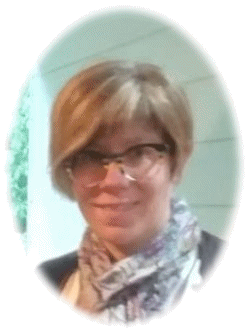
Last summer I made myself a very special gift: to return to my beloved Japan. I had already been there in 2012, when the Theological Faculty of Triveneto had awarded me a scholarship on interreligious dialogue, allowing me to live in a temple of the Sōtō Zen tradition and to attend some courses at a university in Tōkyō. It was during the preparation of that trip that, thanks to a priest of Padova Diocese, I got to know the Xaverian missionary Maria De Giorgi and the reality of Shinmeizan. On that occasion, unfortunately, I had not been able to visit Shinmeizan, but I promised myself that if I ever returned to the Land of the Rising Sun, that would be one of my destination. And so it was.
I was led to Shinmeizan by the strong interest in the dialogue between Christianity and Japanese religions, and the "curiosity" to see with my own eyes the missionary activities going on in an industrialized and technological Country such as Japan. I left without particular expectations, ready to welcome everything that I would have seen, heard and done, as a gift. I stayed over at Shinmeizan for about ten days, finding a family atmosphere that made me feel at home. The small community that animates this place is made up by P. Franco Sottocornola, P. Pietro Yoshiaki Sonoda, Maria De Giorgi and Emiko Tomozoe, courteous and helpful people who made this experience unforgettable. In dialogue with them, I got to know better Shinmeizan's history and purposes, to have information on the Christian presence and activities on the island of Kyūshū and to deepen some aspects of Japanese culture.
Here I had the opportunity to cultivate my spirituality, not only through participation in the Holy Mass and daily moments of prayer, but also through the silent practice of samu (simple manual activities aimed at taking care of the internal and external environments of the place). In the stillness of awakening nature, I was able to contemplate the intimate beauty of creation, to thank for this precious gift and renew my commitment to take care of it. By carrying out with due attention and concentration the tasks that were entrusted to me, such as sweeping the fallen leaves or weeding out the weeds, I had the impression of freeing my mind from many thoughts that prevented me from grasping the essence of things and distracted me from my real goals. Gradually, I regained my inner balance and felt the pleasant sensation of being in harmony with everything. How I needed it!
If through “samu”, I discovered a solitary "meditation in action", in the monthly retreat - which I could take part in - I lived dialogue as a shared religious experience. On this "retreat" day, Christians and non-Christians were present. Gathered in the hondō (the prayer room), some passages from the Gospel were read under the guidance of Father Franco. For those who had already embraced the Christian faith, it was a way to deepen and meditate on them, for those who had not yet done so, it was an opportunity to get to know and to approach the Christian message. The reading and explanation of the chosen passages was alternated with moments of personal reflection, comparison and conviviality, which allowed me to experience the beauty of the encounter and exchange with people willing to welcome the Gospel message, to be questioned and provoked by it, but also willing to build friendly and collaborative relationships beyond the own religious affiliation.
The encounter with a Japanese girl who did not participate in the retreat, but who reached Shinmeizan for a catechesis with sister Maria, was for me a great emotional impact. In the short conversation I had with her, I felt called to give a testimony of my faith. It was not new for me, but this time it was different. It seemed to me that her questions did not stem from a simple curiosity, but from a tormented desire to understand why and how being Christian could make a difference. I felt the responsibility to help her to support faith and to alleviate her inner anxiety. If the Church is "by its nature missionary" (AG n. 2), at that moment I felt to be a missionary too and it was exciting. In that right moment I rediscovered the joy of “proclamation”!
The enthusiasm personally felt helped me to look critically at the attitude of the missionary group I belong to. I realized that we are focusing only on the humanitarian support of peoples experiencing situations of material poverty, forgetting that this is only a way but not the essence of missionary activity.
There are many forms of poverty and one of these, spiritual poverty, affects, in a subtle way, societies of well-being. Being missionaries means taking care of the whole person, feeding the body but above all the soul and filling the spiritual voids. The missionary is the one who, making his own style the style of Jesus, witnesses the love of God who never abandons us because through the mystery of Incarnation chose to live our life, facing the darkest moments of human existence and prompting us not to be afraid, because true life is the communion with Him.
After my departure and my return to Italy, I often rethought this experience sharing it with other persons, feeling it too important to keep it closed in a corner of my memory. I will always take with me the lessons learned in this place, where I left a part of my heart. One day (I hope very soon) I will return to Shinmeizan, but that will be another adventure.